
 Free Demo Class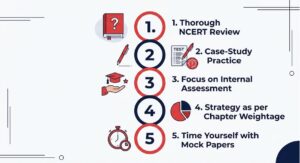
In all my years of teaching Class 10 and 12 students, I hear the same doubt every single session: “Ma’am, the syllabus looks more or less the same, so why does the paper feel tougher?” The honest answer is — it is usually not the content, it is the pattern. Here are five simple, practical tips I give all my own students to help them crack the CBSE Maths exam pattern with confidence.
- Be thorough with NCERT first, then move to extra material CBSE papers are still firmly based on NCERT textbooks. Before jumping to reference books or online question banks, I always insist that every NCERT example and exercise is crystal clear first. This alone covers a large chunk of the paper.
For the exact chapter list, refer to the official CBSE syllabus PDFs:
📄 Class 10 Maths Syllabus 2026-27
📄 Class 12 Maths Syllabus 2026-27
- Practise case-study questions every week As case-study and competency-based questions now carry good weightage, I don’t let my students leave these for the last month. We solve at least 2-3case-study problems every week in class, so the format feels familiar and not intimidating on the day of the exam.
- Don’t take internal assessment lightly With 20 marks kept aside for periodic tests and maths activities, this is not “extra” — it is a guaranteed chunk of the final score. I always tell parents: please take every class test and project seriously, right from the start of the session, not just before the boards.
- Plan revision as per chapter weightage All chapters are not equal in marks. In Class 12, for example, Calculus alone carries the highest marks. I guide my students to give revision time accordingly — more hours to high-weightage chapters, lighter revision to smaller ones — instead of spreading equal time everywhere.
- Time yourself while solving mock papers Over the years, I have seen many bright students know the concepts well, but still lose marks due to poor time management in the exam hall. I make my students solve at least 3-4 full-length mock papers in exam-like time conditions before the boards, so that pacing becomes second nature by exam day.
Maths does not have to be stressful. With the right guidance and a plan built around the actual exam pattern, I have seen most of my students turn Maths into their strongest, most scoring subject — and I would love to help your child do the same.
Want a personalised plan for the 2026-27 session? Book a free demo class with me today, and let’s work out a strategy that suits your child.
Kavita Rana