
 Free Demo Class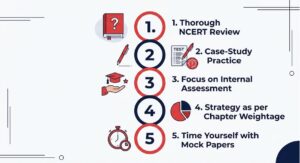
5 Simple Tips to Master the CBSE Maths Exam Pattern in 2026-27
Tuesday, 21 July 2026
In all my years of teaching Class 10 and 12 students, I hear the same doubt every single session: “Ma’am, the syllabus looks more or less the same, so why does the paper feel tougher?” The honest answer is — it is usually not the content, it is the pattern. Here are five simple, practical tips I give all my own students to help them crack the CBSE Maths exam pattern with confidence. Be thorough with NCERT first, then move to extra material CBSE papers are still firmly based on NCERT textbooks. Before jumping to reference books or online question banks, I always insist that every NCERT example and exercise is crystal clear first. This alone covers a large chunk of the paper. For the exact chapter list, refer to the official CBSE syllabus PDFs: 📄 Class 10 Maths Syllabus 2026-27 📄 Class 12 Maths Syllabus 2026-27 Practise case-study questions every week As case-study and competency-based questions now carry good weightage, I don’t let my students leave these for the last month. We solve at least 2-3case-study problems every week in class, so the format feels familiar and not intimidating on the day of the exam. Don’t take internal assessment lightly With 20 marks kept aside for periodic tests and maths activities, this is not “extra” — it is a guaranteed chunk of the final score. I always tell parents: please take every class test and project seriously, right from the start of the session, not just before the boards. Plan revision as per chapter weightage All chapters are not equal in marks. In Class 12, for example, Calculus alone carries the highest marks. I guide my students to give revision time accordingly — more hours to high-weightage chapters, lighter revision to smaller ones — instead of spreading equal time everywhere. Time yourself while solving mock papers Over the years, I have seen many bright students know the concepts well, but still lose marks due to poor time management in the exam hall. I make my students solve at least 3-4 full-length mock papers in exam-like time conditions before the boards, so that pacing becomes second nature by exam day. Maths does not have to be stressful. With the right guidance and a plan built around the actual exam pattern, I have seen most of my students turn Maths into their strongest, most scoring subject — and I would love to help your child do the same. Want a personalised plan for the 2026-27 session? Book a free demo class with me today, and let’s work out a strategy that suits your child. Kavita Rana
- Published in Recommended Books & Tools
CBSE Maths Syllabus 2026-27: What Students & Parents Should Know
Tuesday, 21 July 2026
Every year around this time, parents call me with the same worry: “Ma’am, has the Maths syllabus changed this year?” So I sat down and went through the official CBSE curriculum for 2026-27 myself, and I want to share a simple, clear summary with all of you — no jargon, just what actually matters for your child’s preparation. No major surprises this year, but do check the official PDF There are no drastic changes in the overall exam structure. Class 10 and Class 12 Maths will continue with the familiar 80 marks (theory) + 20 marks (internal assessment) pattern. Internal assessment includes periodic tests and maths activities/projects, so I always tell my students — regular classwork matters just as much as the final exam, not less. You can download the official syllabus directly from the CBSE Academic website: 📄 CBSE Class 10 Mathematics Syllabus 2026-27 (Official PDF) 📄 CBSE Class 12 Mathematics Syllabus 2026-27 (Official PDF) The trend I keep telling my students to watch: competency-based questions Over my 20+ years of teaching, I have seen CBSE shift steadily towards competency-based and case-study questions, rather than plain rote-learning or formula-recall type questions. This means a child needs to understand a concept well enough to apply it in a new, real-life type situation — not just mug up the steps. For example, a Calculus question may now come wrapped in a real-life scenario, like finding the fastest route or the least-cost option, instead of a plain, direct equation. I have found that once students see this shift clearly, the fear around it actually reduces. Chapter weightage still matters In Class 12, Calculus continues to carry the highest weightage among all units, followed closely by Algebra and Vectors/3D Geometry. For students who are also preparing for competitive exams like JEE or CUET along with boards, this overlap is genuinely useful — strong basics in Calculus and Vectors help in both at the same time. What I recommend you do right now: Download the official syllabus PDF (links above) and confirm the exact chapter list for your child’s class — small changes can happen even in an otherwise “stable” year. Don’t wait for every doubt to get cleared before starting. Begin with the core chapters — Polynomials, Trigonometry, Calculus basics — as these form the foundation no matter what. Practise case-study and application-based questions regularly, not just the usual textbook exercises. If you would like a clear, personalised study plan based on the latest CBSE pattern — one that suits your child’s pace and target score — do book a free demo class with me, and let’s make this syllabus feel a lot less overwhelming, together. Kavita Rana
- Published in Recommended Books & Tools

NCERT Learning Videos
Thursday, 15 June 2023
https://ncert.nic.in/video-gallery.php
- Published in Recommended Books & Tools
CBSE Updates
Saturday, 18 February 2023
Click to Visit CBSE Website https://www.cbse.gov.in/
- Published in Recommended Books & Tools, Resources

NCERT
Saturday, 18 February 2023
Click to download NCERT Books https://ncert.nic.in/textbook.php
- Published in Recommended Books & Tools, Resources